
Playground Has Moved Indoors, And That‘s a Good Thing
Remember the playground at school? The one where you’d sprint the moment the bell rang, fight for a spot on the monkey bars, and come home with scraped palms and the biggest grin of the day? That was more than just fun. That was your brain and body doing some of their most important developmental work, building strength, testing limits, learning to persist, and figuring out exactly what you were made of.
Now fast-forward to today’s children. The bell rings. They come home. And most of them head straight to a screen.
The playground hasn’t gone anywhere. But the opportunity to reach it, especially in UAE summers, during homework hours, or simply after a long day, has become inconsistent at best. That’s the problem Pine & Oak set out to solve.
Our indoor monkey bars bring the single most valuable piece of playground equipment directly into your home. No traffic. No waiting for weekends. Just four walls, one sturdy installation, and a childhood’s worth of physical and mental development waiting to happen.
This blog covers everything you need to know about indoor monkey bars, what they are, what they do for your child, and why, at Pine & Oak, we believe they may genuinely be the only indoor playground your child will ever need.
What Are Monkey Bars, and Why Have They Lasted 100 Years?
Monkey bars were invented in 1923 by an American mathematician, Sebastian Hinton, who was inspired by the natural swinging and climbing instincts that children share with primates. His original design was simple: a series of horizontal overhead bars, spaced so that a child could grip one and swing forward to reach the next.
One hundred years later, the design principle hasn’t fundamentally changed because it doesn’t need to. What Hinton built was not just a play structure. It was a near-perfect instrument for developing the human body during its most rapid period of growth.
Anthropologists at Dartmouth University have recently weighed in on the debate, publishing research that argues strongly for keeping monkey bars in children’s lives. Their findings suggest that climbing and bar play fulfill what they describe as an evolutionary need, one that goes back millennia and plays a critical role in developing the physical and cognitive capabilities
Children need to thrive. The research specifically warns that a culture of “surplus safety,” where challenging equipment is removed in the name of caution, may come at a steep developmental cost.
In short, monkey bars have lasted 100 years because they work. And today, Pine & Oak brings them indoors.
Why Indoor Monkey Bars? Why Not the Park?
This is a fair question, and it deserves a direct answer. Parks and outdoor playgrounds are wonderful. We are not suggesting you stop going to them. But consider the reality of family life in the UAE:
The climate. For six to eight months of the year, outdoor play in the UAE is limited by extreme heat. A child who can only play outdoors in comfortable weather gets a fraction of the active play their body and brain require.
The schedule. After school, homework, dinner, and bath time, a trip to the park requires effort and planning that most evenings simply don’t allow. Indoor monkey bars require none of that.
They’re there, right on the wall, available at 4 PM or 7 PM or on a rainy winter morning.
Supervision ease. An indoor installation allows parents to keep children within sight while completing household tasks. No park run required.
Daily consistency Child development experts consistently emphasise that the benefit of physical play comes from regularity, not occasional bursts. A child who climbs for 20 minutes every day develops meaningfully faster than one who spends two hours at a playground once a week.
Year–round availability School holidays, bad weather, illness in the family, a parent’s busy week, none of these interrupt an indoor installation.
The park is for weekends. Indoor monkey bars are for everyday.
The 8 Developmental Benefits of Monkey Bars (Backed by Research)
This section is the heart of the blog because understanding what monkey bars actually do for your child transforms them from “a fun piece of equipment” into “one of the smartest investments a parent can make.”
- Upper Body Strength That Sets Children Up for Life
Every time a child grips a bar and shifts their weight forward, they are engaging the muscles of their hands, forearms, biceps, shoulders, and upper back simultaneously. This is the kind of compound, functional strength that gym machines struggle to replicate, even in adults.
Children who develop strong upper bodies early carry that strength into every physical pursuit they choose, such as swimming, gymnastics, martial arts, football, or simply carrying their school bag without slouching.
- Grip Strength and Fine Motor Control
Grip strength is one of the most under-discussed indicators of overall health and physical capability in children. It directly influences handwriting quality, the ability to play a musical instrument, and performance in virtually every sport. The repeated gripping motion involved in monkey bar play builds this strength progressively and naturally far more effectively than any hand exercise designed for the purpose.
- Core Strength and Postural Integrity
The core is the body’s centre of gravity. Every movement made on monkey bars, hanging, swinging, transitioning from bar to bar, requires the core muscles to stabilise the body.
Children who regularly use monkey bars develop strong abdominal and lower back muscles that support healthy posture, reduce the risk of back pain in later life, and dramatically improve athletic performance across all disciplines.
In a world where children increasingly spend hours slouched at desks or hunched over screens, core strength developed through active play is not a luxury. It is a necessity.
- Hand-Eye Coordination and Motor Planning
To move from one bar to the next, a child must judge distance, time their reach, coordinate the release of one hand with the grab of the other, and adjust for the momentum of their own swinging body. This sequence of micro-decisions happens in fractions of a second and represents one of the richest forms of motor planning available in childhood play.
This kind of coordination translates directly to academic skills; writing, drawing, and typing all rely on the same hand-eye precision that monkey bars develop.
- Balance, Proprioception, and Body Awareness
Proprioception, the body’s sense of its own position in space, is developed through exactly the kind of dynamic, unpredictable movement that monkey bars demand. As children navigate the bars, they develop what scientists call body awareness: a deep, instinctive understanding of where their limbs are, how to shift their weight, and how to control their movement with precision.
This skill is fundamental to athletic performance, to safe navigation of physical environments, and to confidence in the body itself.
- Confidence, Resilience, and the Growth Mindset
Few experiences in childhood are as psychologically powerful as succeeding at something that once seemed impossible.
The first time a child makes it all the way across the monkey bars, something shifts in them. They have direct, physical proof that persistence, effort, and courage produce results. This isn’t a lesson learned from a book or a conversation with a parent. It is learned through the body, and it sticks.
Research from child psychologists consistently shows that the confidence gained from mastering physical challenges like monkey bars extends into academic performance, social interactions, and the general willingness to attempt difficult things. The monkey bars may be the first place your child truly learns what it means to try, fail, try again, and succeed.
- Cognitive Development and Stress Relief
Physical play is not separate from brain development; it is one of its primary drivers. Children who engage in regular vigorous physical activity show measurably better concentration, improved memory, reduced anxiety, and more stable moods than their less-active peers.
A child who has spent 20 to 30 minutes on the monkey bars before sitting down to homework is a fundamentally more focused, more regulated version of the same child who came straight from a screen. This is not anecdotal. It is the conclusion of decades of research in child psychology and neuroscience.
- Joint Health and Flexibility
Hanging and swinging from overhead bars provides a form of traction for the spine and shoulder joints that is remarkably difficult to replicate in any other way. The motion gently decompresses the vertebrae, lubricates the shoulder, elbow, and wrist joints, and stretches the muscles of the chest, back, and side body.
For children going through growth spurts often accompanied by the aches and tightness that parents know as growing pains, regular time on the monkey bars provides natural, effective relief.
Pine & Oak’s Indoor Monkey Bars: Built for UAE Families
Not all indoor monkey bars are the same. Here’s what makes Pine & Oak’s offering the right choice for your home.
Premium Natural Wood
Every Pine & Oak monkey bar set is crafted from premium-grade pine and oak woods selected
for their combination of structural strength, smooth finish, and natural warmth. We do not use compressed wood, plastic-coated materials, or synthetic frames. Our bars feel the way wood should feel: solid, warm, and honest in the hands.
UAE Climate Engineering
Our materials and finishes are selected and tested to perform in the UAE’s specific climate conditions where homes move between air-conditioned interiors and the ambient humidity of outdoor heat. Our wood treatment process prevents the warping, cracking, and joint loosening that cheaper materials experience over time in this environment.
Wall-Mounted Stability
Pine & Oak monkey bars mount directly and permanently to your wall, creating a structure that does not wobble, shift, or flex under load. This is the only acceptable standard for overhead equipment that children will swing their full body weight from.
Modular and Expandable
Our monkey bar systems are designed to grow with your child and your family:
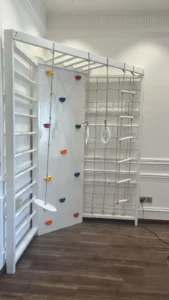
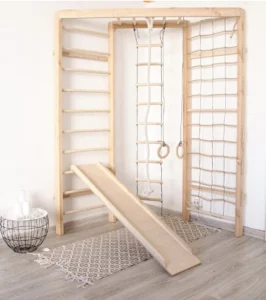
- Horizontal bar traverses for classic bar-to-bar swinging, rope ladders for climbing up to bar height from below
- Gymnastic rings for swing-based upper body training, hanging ropes for grip and climbing challenges
- Swing bars for younger children, building confidence Pull-up bars for older children and adults
Start with the essentials and add modules as your child’s capabilities grow. Every Pine & Oak accessory integrates with our core monkey bar frame.
Space-Efficient by Design
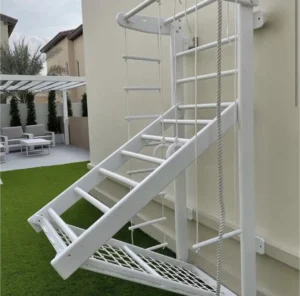
Our indoor monkey bar installation is fully wall-mounted, meaning it uses vertical and overhead space rather than consuming your floor plan. The ground beneath the bars stays completely free for soft mats, for younger siblings to play safely, or simply for your living space to remain your living space.
Age-by-Age Guide: How Your Child Will Use Indoor Monkey Bars
One of the most common questions we receive at Pine & Oak is: “Is my child old enough for monkey bars?” The honest answer is: there’s a version of monkey bar play for almost every age.
Toddlers (Ages 1–3)
At this stage, the focus is not on traversing bars but on grip, hang, and supervised exploration. Holding on while a parent supports their weight, reaching for the lowest bar, and developing that foundational hand and arm strength are all appropriate and enormously beneficial at this age.
Preschoolers (Ages 3–5)
Children at this age begin attempting short sequences reaching from one bar to the adjacent one, practising swinging, building the confidence to let go and reach forward. This is the age of breakthrough moments: the first successful two-bar swing is a memory both child and parent carry for years.
Primary School Age (Ages 6–10)
This is peak monkey bar territory. Children at this age have the physical capability and the competitive spirit to push themselves — longer traverses, timed challenges, invented games, gymnastics moves. Accessories like rings and ropes open entirely new challenge levels that sustain engagement as strength and skill increase.
Tweens and Teens (Ages 11+)
Monkey bars transition naturally into fitness equipment for this age group. Pull-ups, hanging core exercises, ring work, and strength training become the focus. A teenager with access to indoor monkey bars has a home gym that supports athletic development across every sport they pursue.
Adults
Pine & Oak monkey bars are rated to support adult weights. The same installation used by your seven-year-old is also perfectly suited for your morning pull-up routine, shoulder mobility work, and spinal decompression hangs. Families consistently tell us that the monkey bars become a shared daily ritual — child and parent using the same structure for complementary purposes.
The Safety Question: Honest Answers
We believe in being transparent about the realistic safety considerations that come with any overhead play equipment.
Do children fall from monkey bars?
Yes, occasionally. This is why we always recommend placing a thick gym mat or soft play flooring beneath the installation. Supervised use is especially important for younger children.
Is the risk significant?
Research puts this in perspective. The risk of falls from monkey bars is real but statistically modest, and the developmental cost of removing all challenging physical play from childhood is arguably far greater. The goal is managed risk, not no risk.
Will wall mounting damage my home? Installation requires drilling into your wall, creating anchor points for the support brackets. These fixings are clean, minimal, and straightforward to fill and repaint should you ever move. The structural integrity they provide is non-negotiable for safe overhead use.
What age is appropriate to start unsupervised use?
This varies by individual child, but as a general guideline: children under five should always have a parent or carer within arm’s reach. Children over seven with established bar confidence can typically be given more independence, with a parent nearby in the home.
How to Choose the Right Pine & Oak Monkey Bar Setup
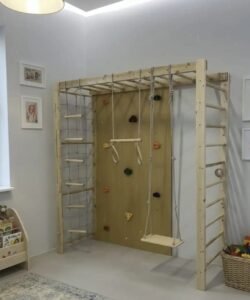
We offer monkey bar configurations suited to different home sizes, age ranges, and budgets. Here’s a simple framework for choosing: For toddlers and preschoolers as the primary users: Start with a lower-mounted bar configuration and include a rope ladder for access. Prioritise surface-to-bar height carefully the lower the bars, the shorter the drop, and the more independently young children can use the structure.
For primary school children: A full horizontal traverse is the ideal starting point, paired with gymnastic rings. This combination sustains engagement for years as strength and creativity grow. For families with a wide age range: Choose a modular system that allows you to configure bar heights and accessories for different users simultaneously. Our largest configurations can serve a toddler and a teenager at the same time. For adults who want to use the equipment too: Ensure the installation height allows for a full dead hang without feet touching the floor. Our team can advise on the ideal mounting height for your ceiling and family requirements.
Visit www.pineandoak.ae to explore the full range, or contact our team directly for a personalised recommendation.
What Parents in the UAE Are Saying
The feedback from Pine & Oak families across Dubai, Abu Dhabi, and Sharjah has been consistent and deeply gratifying.
Parents tell us that the first week after installation typically involves hours of daily use, an initial burst of excitement that settles into a genuine, sustainable daily habit within a month. Children who were previously anchored to screens discover a physical challenge they find genuinely compelling. Siblings who couldn’t agree on what to play suddenly have a shared obsession.
Parents also tell us something we find particularly meaningful: that the monkey bars seem to change their children’s relationship with challenge. A child who spent weeks unable to complete a full traverse, who fell and tried again day after day, who finally made it across and erupted in celebration, that child carries something forward. They become, in small but real ways, less afraid of difficult things.
That is what good play equipment does. And it’s why Pine & Oak exists.
Monkey Bars vs. Other Indoor Play Options: A Clear Comparison
| Indoor Play Option | Developmental
Value |
Longevity | Space Required | UAE Suitability |
| Tablet and screen time | Low | Ongoing | Minimal | High (but problematic) |
| Soft play foam set | Low–Medium | 2–3 years | Significant floor space | Medium |
| Indoor trampoline | Medium | 3–4 years | Large floor space | Medium |
| Ride-on toys / scooters | Medium | 3–5 years | Large open area | Medium |
| Pikler triangle / toddler climber | Medium–High | 3–5 years | Moderate floor space | High |
| Pine & Oak Indoor Monkey Bars | Very High | 10+ years | Minimal (wall + overhead) | Very High |
How to Order Your Pine & Oak Indoor Monkey Bars
Ordering is straightforward. Visit www.pineandoak.ae, browse our monkey bar range, and select the configuration that suits your home and your children’s age range.
We deliver across the UAE. Full installation hardware, fixings, and instructions are included with every order. Our accessories rings, ropes, swing bars, and more can be bundled at the time of purchase or added to your order at any stage.
Final Thought: Some Things Don’t Need Improving
In an age of digital toys, AI-powered learning tools, and subscription-based entertainment platforms, there is something quietly radical about a piece of wood, a wall, and a child using their own strength and determination to get from one end to the other.Monkey bars have been developing children for a century. They have outlasted every trend, survived every wave of over-cautious removal, and come through every decade still doing exactly what they were designed to do — building strong, capable, confident children one grip at a time.
At Pine & Oak, we bring that timeless tool into UAE homes, crafted with the premium materials and thoughtful design that your family deserves.
Your wall is waiting. Your child is ready.
Shop the Pine & Oak indoor monkey bar range at www.pineandoak.ae
Pine & Oak is a UAE-based retailer specialising in premium natural wood play equipment and children’s furniture. Every product is selected for its developmental value, material quality, and lasting relevance to family life. Visit us at www.pineandoak.ae.
